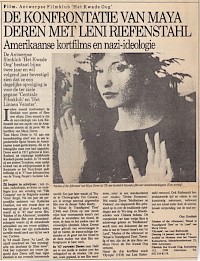
Maya Deren’s confrontation with Leni Riefenstahl: American short films and Nazi ideology
The Antwerp film club 'Het Kwade Oog' has been around for almost two years and wants to confirm next year that it is a solid successor to the defunct 'Centrale Filmklub' and 'Het Linnen Venster'
Every month the film club confronts two genres or films with each other. This month it is the Nazi ideology of Leni Riefenstahl with an aspect of American cinema from the 1940s: the short films of Maya Deren.
When Maya Deren died of a brain haemorrhage in '61, she was a legendary figure in American avant-garde cinema, which she had largely helped found. Deren was born in 1917 in Kiev, Russia, to intellectual Russian Jewish parents. In '34 she became an active Trotskyist, but under the influence of the sham trials in the Soviet Union and the Nazi-Soviet pact she terminated her membership of the Young People's Socialist League in '37.
She starts writing: a novel, radio scripts, articles and translations (including a translation of "Ville Conquise" by the Belgian socialist Victor Serge). After a year as personal assistant to Katherine Dunham, with whose black dance and theater group she travels through America, she makes her first film in '43. "Meshes of the Afteroon", now a classic film about dream landscapes in which she depicts the awakening sexuality of a woman. With its symbolic surreal world, the film is strongly reminiscent of the work of Cocteau. In '44 Deren made 'At Land', which she herself described as "a mythological journey through the 20th century". Here too, a woman (played by Deren herself) explores her own identity in a strange, enchanting world. A year later she made Study in Choreography For Camera, a film about the dancer Talley Beatty, elaborated in strict simplicity. In 'Ritual In Transfigured Time' (1946) Deren manages to merge her main themes in a very beautiful way: the ritual, the myth, the dance and the search for female identity. Maya Deren's intense use of distortions in time and space, the trance-like states and the spirit of ritual in the dance make this film a highlight of her work.
In '47 Deren leaves for Haiti to make a study of folk beliefs and rituals. This would not result in a film, as planned, but in a standard text about voodoo, "Divine Horsemen". Deren does make "Meditations on Violence", a refined film based on and about the traditional training at the Wu-tang and Shaolin schools for Chinese boxing. The complexity of her previous films is left behind and "Meditations" becomes more of a document that echoes the 'trance' themes of "At Land", "Meshes of the Afternoon" and
"Ritual in Transfigured Time". Coincidentally or not, these are the three films by Maya Deren that Het Kwade Oog shows.
In addition to these three short films, Olympia' (1938) by Leni Riefenstahl will be shown. Riefenstahl also restructured time and space in an artificial universe, albeit with a completely different goal: the international spread of the Nazi myth.
Guy Goethals
“Meshes of the Afternoon”, “Ritual in Transfigured Time” and “At Land” by Maya Deren. "Olympia", by Leni Riefenstahl.
Tuesday, January 16, starting at 8 p.m.
Archive and Museum for Flemish Cultural Life, Minderbroederstraat 22, 2000 Antwerp.
Film Club The Evil Eye. Kattenberg 122, 2200 Antwerp.
(03) 236 82 59.